




What Is Percale? The Crisp, Cool Weave Explained
Updated September 2026.
Short answer: percale is a tight cotton plain weave where each thread goes over one and under one. The weave gives a matte, smooth and crisp surface that breathes and feels cool against the skin, the feeling many associate with freshly made sheets at a good hotel. Percale usually has a thread count of about 180 and up. Boe's own percale bedding is called Ralph and is woven at 200 TC.
What is percale?
Percale is a way of weaving, not a type of cotton. More precisely, it is a tight version of plain weave, the most basic weave of all: each weft thread crosses the warp over one, under one, again and again. The threads are bound equally often in both directions, and the result is a balanced, stable and dense weave.
Reference works describe percale as a closely woven plain-weave fabric often used for bedding, with a thread count of about 180 or higher. So the name says nothing about which cotton the thread is spun from; it describes how it is woven.
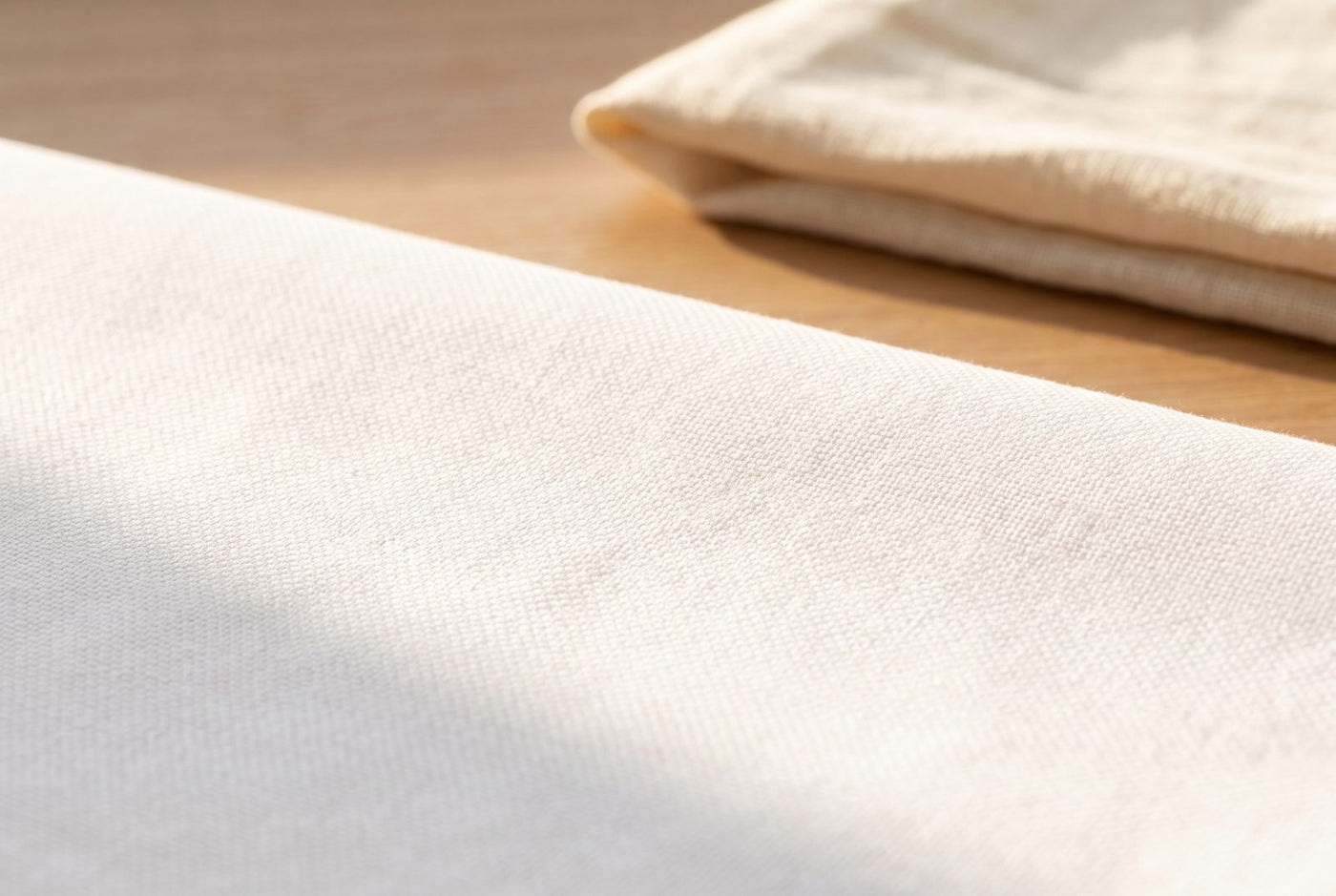
The even structure is the whole point. No thread lies on top as a long float, so the surface gets no shine. It becomes matte, smooth and dry to the touch. Many describe it as a good freshly pressed shirt, or as the cool side of the pillow.
Why does percale feel so cool?
Because the weave breathes. The tight but airy plain weave leaves small, even gaps between the threads that let air through, and the matte surface lies against the skin without trapping heat. Moisture moves away more easily. That is why percale is seen as one of the coolest choices if you easily get warm at night.
- Breathes: the balanced weave lets air through.
- Matte surface: no glossy finish that feels clammy when it gets warm.
- Firm drape: the sheet lies smooth and taut over the mattress.
- Crisp touch: a clean, cool feeling the moment you get into bed.
Is a 200 thread count enough for percale?
Yes. For percale, a moderate thread count is exactly what the weave needs. Thread count is the number of threads per square inch, warp and weft combined, and percale usually starts around 180. Around 200 you get a dense, smooth surface that still breathes and keeps its crispness.
Very high thread counts require either extremely thin threads or counting multi-ply threads several times. The fabric then often becomes denser, heavier and warmer, which goes against everything percale stands for. That is why Ralph is woven at 200 TC. How to read the number is explained in Thread count explained.
What is the difference between percale and sateen?
Percale is matte, crisp and cool; sateen is smooth, slightly glossy and warmer. The difference lies in the weave: in sateen the thread floats over several threads before turning, and the long floats give sheen and a softer drape. Neither is finer; they are made for different temperaments.
| Percale | Sateen | |
|---|---|---|
| Weave | Plain weave, over one and under one | Satin weave with long floats |
| Surface | Matte, dry, crisp | Smooth, with a slight sheen |
| Temperature | Cool, breathes well | Slightly warmer, more enveloping |
| Drape | Firm, lies smooth | Soft and flowing |
| Suits you if you | sleep warm and like a freshly pressed feel | want it silky smooth |
If you want the very softest, there is a third path: Supima cotton, an extra-long-staple cotton. Boe weaves it at 300 TC in the Regency Lee range. The comparison is in Percale or Supima.
Is percale OEKO-TEX certified?
That depends on the maker; the weave itself says nothing about chemicals. Ralph is certified to OEKO-TEX Standard 100, which means the textile is tested for a long list of harmful substances and judged safe against the skin. For sheets that lie against you every night, that is a baseline rather than a luxury. More about the label in our guide to OEKO-TEX certified bedding.
How to care for percale
Percale is forgiving and gets softer with every wash without losing its character. Ralph can be washed at 60 °C.
- Wash at up to 60 °C with a mild detergent. Dose sparingly.
- Skip fabric softener. It coats the fibre and dulls the crisp surface.
- Avoid bleach, which weakens the cotton.
- Take the sheets out while slightly damp and smooth them straight away. Then they barely need ironing.
- For the sharpest finish, iron at medium heat while the fabric is still a little damp.
More advice in our bedding care guide, and how the whole bed is built up is in build the perfect bed layer by layer.
Frequently asked questions
What is percale?
Percale is a tight plain weave, usually in cotton, where each thread goes over one and under one. It gives a matte, smooth, crisp and cool surface that breathes. Percale is a weave, not a type of cotton.
Is percale cool to sleep in?
Yes. The balanced, airy weave lets air through and does not trap heat, which makes percale one of the coolest choices if you easily get warm at night.
Is a 200 thread count enough for percale?
Yes. Percale usually starts at a thread count of around 180, and around 200 you get a dense, smooth surface that still breathes. Higher counts tend to give a denser, warmer fabric.
What is the difference between percale and sateen?
Percale is a plain weave that feels matte, crisp and cool. Sateen is a satin weave with longer thread floats that give a slight sheen and a softer, warmer drape.
Does percale get softer over time?
Yes. Percale softens with every wash but keeps its firm, crisp character. Avoid fabric softener, which dulls the matte surface.
Our advice
If you sleep warm, or love the feel of freshly pressed sheets, percale is the right choice. Start with the duvet cover and pillowcases, where you feel the weave most, then add a sheet in the same material so the whole bed feels the same. Boe's own bedding in crisp percale is called Ralph and comes as a bedding set, flat sheet, fitted sheet and pillowcases. The full range is in the percale collection.