




Supima Cotton: Why It Is Considered the Finest Cotton in the World
Updated September 2026.
Short answer: Supima cotton is American Pima cotton with extra-long fibres, sold under the protected Supima trademark. The fibres average nearly twice the length of ordinary cotton, and Supima makes up less than 1 percent of the world's cotton harvest. Long fibres give a smoother, stronger yarn, which is why Supima bedding is soft, durable and has a gentle, natural sheen.
What is Supima cotton?
Supima is a trademark, not a separate plant. The name may only be used for American Pima cotton grown in the USA that meets the brand's requirements, and it is managed by the growers' own organisation, Supima. Pima cotton belongs to the species Gossypium barbadense, the so-called extra-long-staple cotton, which accounts for about 5 percent of world cotton production. The ordinary cotton in most textiles is a different species with shorter fibres.
So Supima is the American top of an already small category. According to Sunspel, Supima represents about 3 percent of the cotton grown in the USA and less than 1 percent of the cotton grown in the world.
Why is Supima considered the finest cotton in the world?
Because of the fibre. Sunspel states that Supima fibres average about 1.5 inches in length, nearly twice as long as other types of cotton. A longer fibre can be spun into a finer, more even and stronger yarn, because fewer fibre ends stick out along the thread. You notice it in the finished fabric:
| Property | Ordinary cotton | Supima cotton |
|---|---|---|
| Fibre length | Shorter | Extra long, about 1.5 inches on average |
| Surface | More loose fibre ends | Smooth and soft |
| Sheen | Matte | Soft, natural sheen |
| Durability | Good | Stronger thread, withstands many washes |
| Pilling | Forms more easily | Less, the surface stays smooth longer |
Sunspel sums up Supima's signature qualities as strength, softness and colour retention. Exactly the qualities you want in something that lies against your skin eight hours every night.
Is Supima the same as Pima cotton?
All Supima is Pima, but not all Pima is Supima. Pima is the name of the extra-long-staple cotton; Supima is the trademark for Pima grown in the USA that meets the brand's quality requirements. Pima cotton is also grown in other countries, for example Peru, but may not then be called Supima.
Sheen is not shine
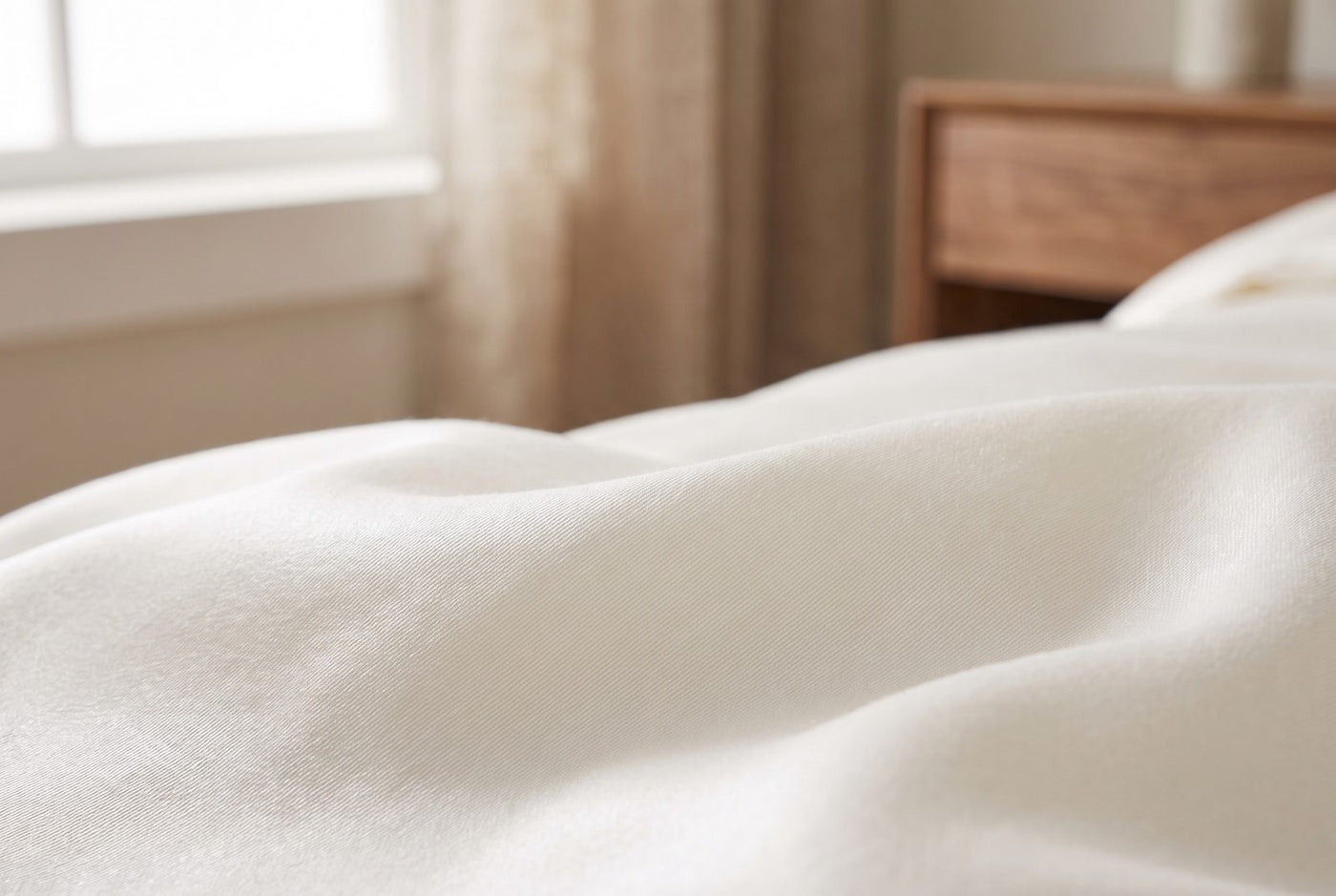
Supima's sheen is sometimes confused with a glossy, synthetic shine, but they are two different things. The sheen comes from the fibre itself: long, even fibres reflect light more evenly. It is not a surface treatment. That is why Supima bedding looks refined without looking artificial; it glows quietly rather than gleams.
How does Supima feel to sleep in?
Soft, quiet and calm. The smooth surface glides against the skin without the slight resistance shorter cotton can have, and the fabric drapes softly over the body rather than standing away from it. Supima rustles less than crisp percale and feels more enveloping, which many appreciate when it gets colder. At the same time it is still cotton, so it breathes and absorbs moisture. The surface often gets softer still after the first washes, and because the thread is strong it keeps its shape for a long time. If you sleep warm, read more about how temperature and materials connect in our guide to bedding and sleep.
What thread count should Supima have?
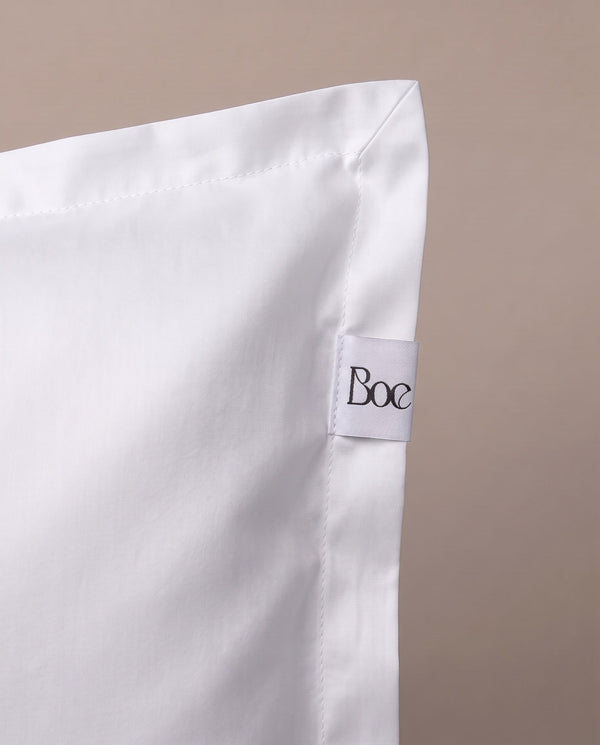
The fibre matters more than the number. Thread count is the number of threads per square inch, and a very high count requires thinner threads or double-counted multi-ply threads. With a long, strong fibre like Supima there is no need for extreme numbers: around 300 gives a weave that is dense and soft yet still breathes. Boe's Regency Lee is woven in 100 percent Supima cotton at 300 TC. How to read the number is explained in Thread count explained.
If you sleep warm and prefer a crisp, matte surface, percale is another path. Boe's own bedding in crisp percale is called Ralph. The comparison is in Percale or Supima.
How to care for Supima
Supima rewards a little care with years of sheen. Regency Lee is also certified to OEKO-TEX Standard 100, tested for harmful substances.
- Wash at up to 60 °C with a mild detergent, and do not overdose.
- Skip fabric softener, which coats the fibre and dulls the sheen.
- Line dry rather than tumble dry hard. The fibre keeps its strength and the surface its glow.
- Iron on high heat if you want a perfectly smooth surface.
- Avoid bleach, except on white textiles.
More advice in our bedding care guide.
Frequently asked questions
What is Supima cotton?
Supima cotton is American Pima cotton with extra-long fibres, sold under the protected Supima trademark. The long fibres give a softer, stronger and more lustrous yarn than ordinary cotton.
Why is Supima called the finest cotton in the world?
Because Supima makes up less than 1 percent of the world's cotton and has fibres that average nearly twice the length of other cotton. That gives softness, sheen, durability and colour retention ordinary cotton rarely matches.
Is Supima the same as Pima cotton?
All Supima is Pima, but only Pima grown in the USA that meets the brand's quality requirements may be called Supima. Pima cotton from Peru, for example, is not Supima.
What thread count is good for Supima?
The fibre matters more than the number. With a long fibre like Supima, a thread count around 300 gives a dense, soft weave that still breathes. Boe's Regency Lee is woven at 300 TC.
How do you wash Supima bedding?
Wash at up to 60 °C with a mild detergent, skip fabric softener and line dry rather than tumble dry hard. Avoid bleach except on white textiles.
Our advice
If you want the softest cotton that can be woven, Supima is the right choice. Start with the duvet cover and pillowcases, where you feel the fibre most. Boe's Regency Lee bedding set is woven in 100 percent Supima cotton at 300 TC, and there are also a flat sheet and pillowcases in the same quality. The full range is in the Supima cotton collection. To build the whole bed step by step, see build the perfect bed layer by layer.