





How to Choose the Right Duvet: Warmth, Weight and Season
Updated September 2026.
Short answer: choose a duvet by how warm you sleep, not primarily by the season. If you sleep warm, choose a cooler duvet that breathes. If you get cold, choose a warmer level. If you are two people with different needs, choose two single duvets in different warmth levels instead of one shared. Then decide the filling by feel: down for lightness, fibre for easy washing and allergies.
How do you choose the right duvet?
A good duvet choice starts with three questions that belong together: how warm you like it, how warm your bedroom is and which season you are sleeping through. They pull in different directions, and it is the balance between them that decides.
| You | Your bedroom | Choose |
|---|---|---|
| Sleep warm | Warm or underfloor heating | A cool duvet, for example warmth level Cool |
| Sleep warm | Cool | Medium, or a breathable fibre duvet |
| Get cold easily | Cool | A warm duvet, for example warmth level Warm |
| Get cold easily | Warm | Medium |
| Normal | Normal | An all-year duvet in medium warmth |
What temperature should the bedroom be?
The bedroom temperature matters as much as the duvet. The Sleep Foundation says most people sleep best in a fairly cool room, around 18 °C, since body temperature drops as we fall asleep. A cool bedroom can justify a slightly warmer duvet, a warm bedroom or one with underfloor heating a lighter one. Read more in The best bedroom temperature.
What if your partner gets cold but you sleep warm?
The simplest answer is two single duvets instead of one shared. Then each of you can choose your own warmth level. The one who sleeps warm takes a cool duvet, the one who gets cold a warmer one, and no one has to compromise.
- Two single duvets in different warmth levels: for example the Sense of Satisfaction Down Duvet 150×210 in Cool for the one who is warm and in Warm for the one who gets cold.
- Different fillings: a down and feather duvet for the one who gets cold and a fibre duvet, like the A Funky Dream Hotel Duvet, for the one who wants it cooler and easy to care for.
- One large duvet: if you have roughly the same needs and want the look of a hotel bed, a 230×220 double duvet that you share works well.
Two single duvets look neat with two duvet covers in the same colour, so the bed still looks unified.
What do warmth level and tog mean?
Both try to answer the same question: how warm does the duvet keep you? Tog is a unit of textile thermal insulation. By definition, a higher tog value means better insulation and so a warmer duvet. Many manufacturers use warmth levels instead, such as cool, medium and warm. Two things are worth keeping apart: tog says nothing about weight, a duvet can be warm without being heavy, and the warmth you feel is always affected by the bedroom and your own temperature regulation. Use the scale as a compass, not an answer key.
Down or fibre in your duvet?
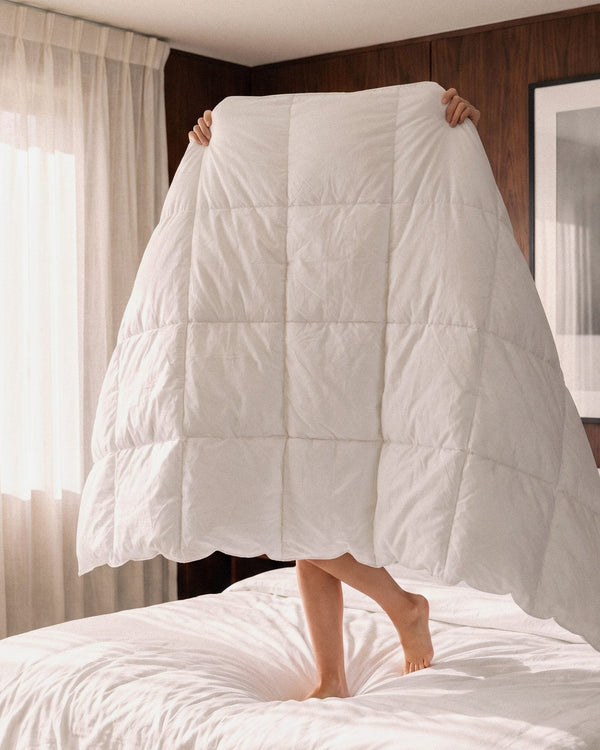
Besides warmth, the filling shapes how the duvet feels. The Sense of Satisfaction Down Duvet has 60% duck down and 40% duck feather in a 100% cotton cover: light, enveloping and breathable. It comes in Cool and Warm in 150×210, and in Cool, Medium and Warm in 230×220.
The A Funky Dream Hotel Duvet is filled with allergy-friendly siliconised fibre, can be washed at 60 °C and is the duvet ESS Group's hotels make their beds with. It is fluffy and cool and suits you if you want an all-year duvet that is easy to care for. We go through the differences between the materials in Down and feather: how to choose the right duvet and pillow.
Which duvet works all year round?
In a normally warm bedroom, an all-year duvet in medium warmth is enough for most people, such as the Sense of Satisfaction Down Duvet in Medium or the fibre duvet from the hotels. If the temperature varies a lot over the year, it can be nice to have a cooler duvet for summer and a warmer one for winter. How to switch between the seasons is covered in Summer bed or winter bed.
How to choose the right duvet
- Start with yourself. Do you kick off the duvet at night or pull it up to your chin? That decides the warmth level.
- Feel the bedroom. A cool room calls for a warmer duvet, a warm room for a lighter one.
- Think of the person you share the bed with. Different needs: choose two single duvets in different warmth levels.
- Choose the filling by feel. Down for lightness and warmth, fibre for allergies and easy washing.
- Choose the size by your bed. 150×210 for one person, 230×220 for a shared double duvet.
- Fine-tune with the duvet cover. Percale feels cool and crisp, Supima soft.
Frequently asked questions
How do I choose the right duvet?
Start with how warm you sleep, how warm the bedroom is and what season it is. If you sleep warm in a warm room, choose a cooler duvet. If you get cold in a cool room, choose a warmer level. Then choose the filling, down or fibre, by the feel you prefer.
Which duvet should we have if one of us gets cold and the other sleeps warm?
Choose two single duvets in different warmth levels instead of one shared, for example one cool and one warm in 150×210. Then each of you can sleep at your own temperature without compromising.
What does tog mean on a duvet?
Tog is a unit for how well a duvet insulates. A higher tog value means a warmer duvet. Low values suit summer, medium values all year and high values winter, but how warm it feels always depends on the bedroom and on you.
Which duvet works all year round?
In a normally warm bedroom, an all-year duvet in medium warmth works for most people. The Sense of Satisfaction Down Duvet in Medium or the A Funky Dream Hotel Duvet in fibre are two good all-year choices.
Is down or fibre best in a duvet?
Neither is objectively best. Down is light, soft and breathes well. Siliconised fibre is allergy-friendly, durable and can be washed at 60 °C. Choose by feel and care rather than by a ranking.
Our advice
Choose a duvet for yourself, not for the season or for the person you share the bed with. If you are two with different needs, two single duvets are the simplest solution. If you want a duvet that works all year and is easy to care for, start with the fibre duvet from the hotels; if you want the lightness of down, choose the right warmth level. All our duvets are under Duvets.